You found the car online for one price. You got a text or email from the dealer. Maybe you even agreed on a number.
Then the buyer's order shows up and the selling price is different.
Before deciding what happened, put the versions next to each other. Seriously. Do not try to reconstruct the deal from memory while staring at the newest worksheet. The fastest way to make sense of a changed car deal is to compare the actual numbers you were given at each step.
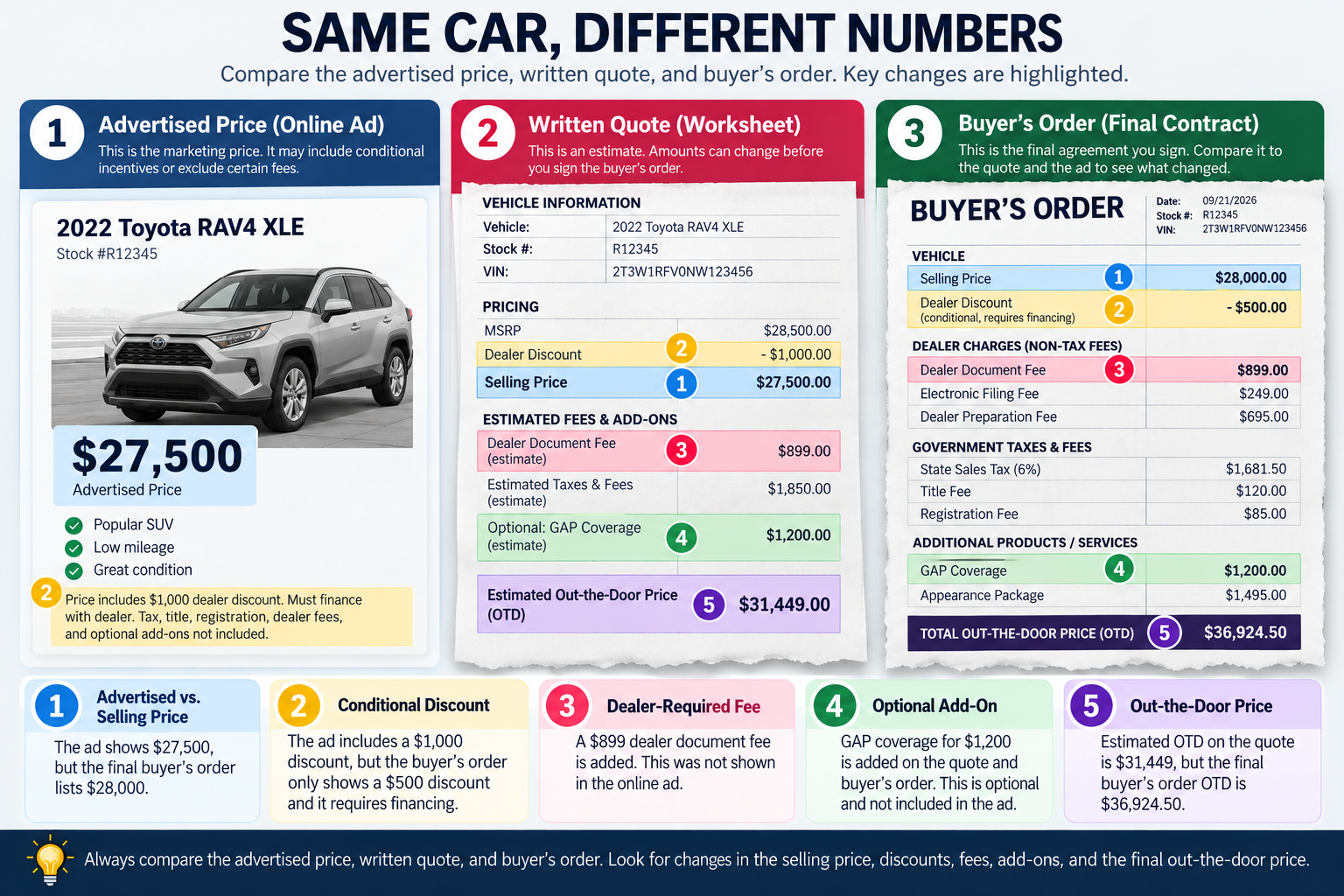
Save every version first
Keep the listing screenshot or PDF if you have it. Save the text or email quote. Keep the first worksheet. Keep the revised one. If the page is still online, save what you can now rather than assuming it will look the same later.
You are building a tiny paper trail, not preparing a courtroom drama. It is simply much easier to ask “why did this line change from X to Y?” when you have both versions in front of you.
Advertised price and OTD price are not the same number
Some difference is normal because OTD includes the total vehicle transaction before financing, including taxes and fees. Government-required charges such as taxes, title, and registration can therefore make the OTD total higher than the vehicle price you saw in an ad.
But that does not mean anything can be piled on top of the advertised vehicle price.
FTC staff's September 2026 automobile pricing guidance says the advertised price must be the actual price any consumer can pay for the vehicle, with government-required consumer charges excluded. Dealer-required charges belong in that advertised price. The guidance specifically addresses mandatory document fees, conditional discounts and rebates, and optional items.
So when the buyer's order starts from a higher vehicle price than the ad, it is worth finding out exactly why.
Check conditional discounts before doing anything else
Look at the advertised number and its fine print. Was part of that price tied to being a first responder, recent graduate, military member, loyalty customer, or using a particular financing arrangement?
The FTC's current guidance says a dealer may advertise those discounts, but the actual price available to any consumer must be the most prominent amount. A discount available only to a subset of buyers should not be used as though everybody qualifies for it.
That gives you a concrete comparison to make: what was the price available to anyone, what conditional discounts were separately offered, and which ones actually apply to you?
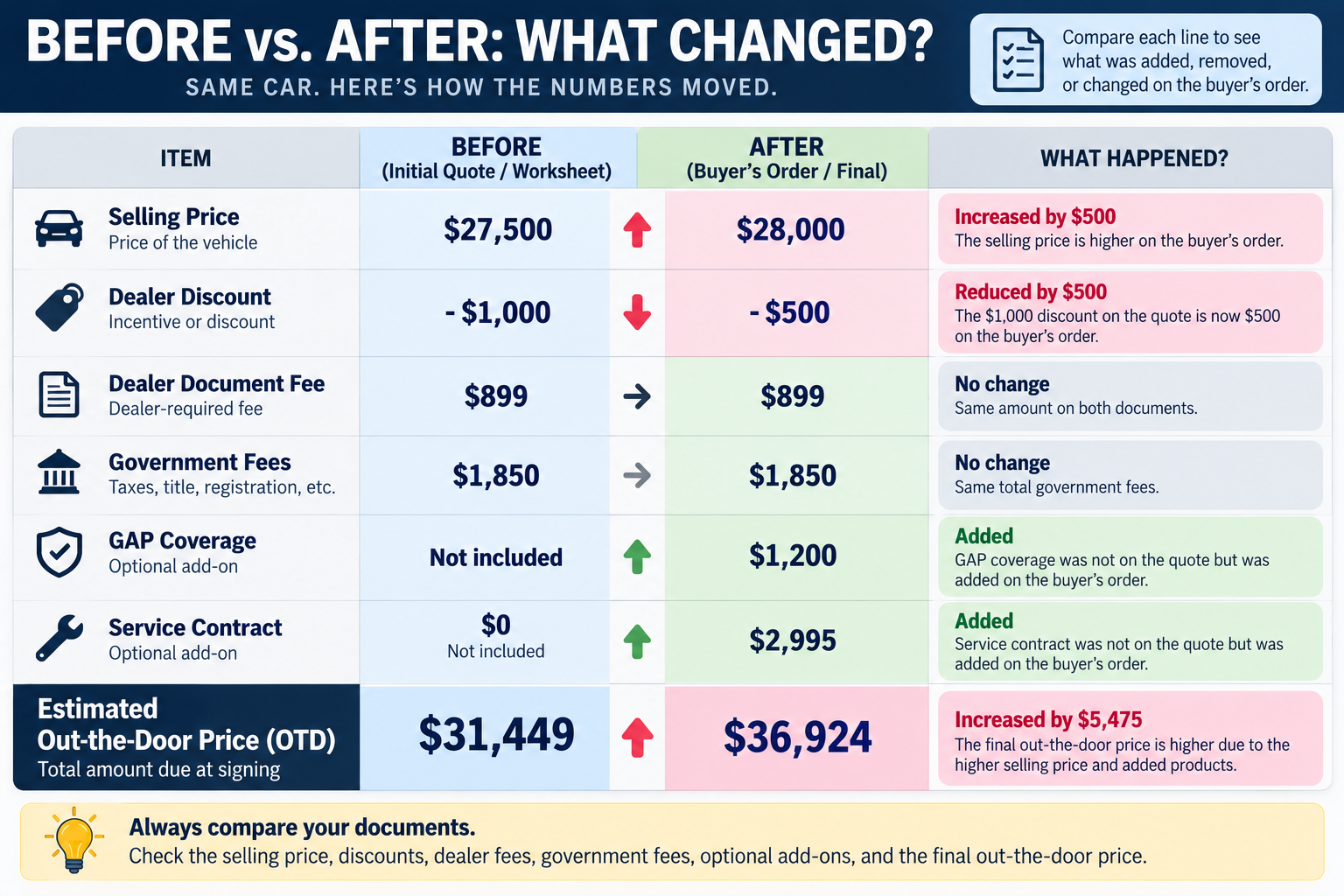
Now compare the documents line by line
I would not start with the monthly payment. I would make a simple change list:
- Vehicle or selling price: same or different?
- Dealer-required charges: present in both versions?
- Government taxes and fees: what changed?
- Rebates and discounts: added, removed, or renamed?
- Add-ons: did any new product appear?
- Trade value: same?
- Cash down or deposit: applied the same way?
- OTD total: same or different?
- Amount financed: did it move because the purchase changed, the credits changed, or both?
Do not assume two labels mean the same thing just because the numbers happen to match. And do not count a subtotal as another charge just because it appears on its own line.
What if the OTD total barely changed?
I would still look at the lines.
A similar bottom line can hide meaningful changes in how the deal is structured. One charge can go up while a discount goes up too. An add-on can appear while another number drops. A trade credit can make a later balance look lower even though the purchase side changed.
That does not automatically make the deal bad. It does mean “the bottom number is about the same” is not the same as “nothing changed.”
Keep financing out of the comparison until the purchase side makes sense
The FTC recommends getting a written OTD price before talking financing. There is a good practical reason for that: once APR, loan term, cash down, trade equity, add-ons, and monthly payment are all moving at once, it gets much harder to see whether the underlying vehicle deal changed.
First compare the vehicle price, purchase charges, products, credits, and OTD total. Then look at how the purchase is being financed.
Questions I would send back to the dealer
- “The advertised price was X and this buyer's order starts at Y. What accounts for the difference?”
- “Which discounts were included in the advertised number, and what were the eligibility requirements?”
- “Was this charge included in the advertised vehicle price?”
- “Is this item optional?”
- “This line was not on the earlier worksheet. What is it?”
- “Can you send me the current out-the-door price in writing before financing?”
Specific questions are harder to answer with another cloud of numbers.
What the current FTC guidance says about price changes
The FTC's September 2026 FAQs say vehicle pricing has to be truthful across dealership websites, third-party sites, social media, print ads, signs, phone calls, and texts. When a webpage states an amount a consumer may pay, the guidance says the actual price should be the most prominent amount.
It also says dealers may negotiate below an advertised price. The problem the guidance addresses is advertising a lower number that is not actually available to any consumer on the stated terms, or adding dealer-required charges later that should have been reflected in the advertised price.
Those FAQs are FTC staff guidance. They explain the staff's view of how the FTC Act applies generally, but the FTC also says the overall impression of a particular advertisement depends on its specific facts. OTD Decoder can help you identify a difference in the paperwork; it cannot decide that a particular dealer violated the law.
Use the paperwork you already have
If you have one version of the deal, paste its line items into the free decoder and organize them. If you have two versions, run through each one and keep the results with the originals so you can compare the same categories instead of trying to compare two completely different layouts.
Leave out or redact Social Security numbers, account numbers, dates of birth, and full street addresses.
If you want another set of eyes on the change
This is the situation where the Deal Sheet Second Look is most useful: you have the ad, quote, buyer's order, or multiple versions, and something changed but you cannot tell exactly where the money moved. The review focuses on reconciling the paperwork and identifying questions to take back to the dealer. It is not a vehicle valuation, legal opinion, or buy/walk recommendation.
Quick answers
Why is OTD higher than the advertised car price?
OTD includes the total purchase price before financing, including taxes and fees. Government-required consumer charges can therefore increase the final OTD amount even when the advertised vehicle price itself has not changed.
Can a dealer advertise a price that assumes a rebate I do not qualify for?
FTC staff's September 2026 guidance says conditional discounts can be advertised, but the actual price available to any consumer must be the most prominent amount rather than a lower price dependent on a discount only some buyers qualify for.
What if an optional product appears on the buyer's order?
Ask what it is, what it costs, and whether you agreed to it. FTC guidance says dealers should not represent optional items as required or charge consumers for options they did not agree to.
Should I compare monthly payments?
Not first. Compare the purchase side and OTD price before financing. A monthly payment can change because of loan term, APR, down payment, financed add-ons, or other credit terms even when the vehicle price does not.