“Non-tax fees: $1,487.”
Cool. Very descriptive.
Dealer paperwork has a talent for turning ordinary money into labels that sound like accounting categories from another planet. Document fee. Processing fee. E-file fee. Reconditioning. Protection package. VIN etching. Nitrogen. Service contract. Then there is the wonderfully specific “non-tax fee.”
The useful question is not whether a fee name sounds suspicious. It is: who is charging it, what is it for, is it required for this transaction, and where does it show up in the total?
“Non-tax fee” is not enough information
A worksheet may group several charges under a heading like non-tax fees. That tells you something about how the dealer's system is treating the amount for that calculation. It does not tell you who imposed each charge or whether an individual item is optional.
Ask for the components. A title or registration charge and a dealer-installed protection product should not become the same thing in your head just because software grouped them under one subtotal.
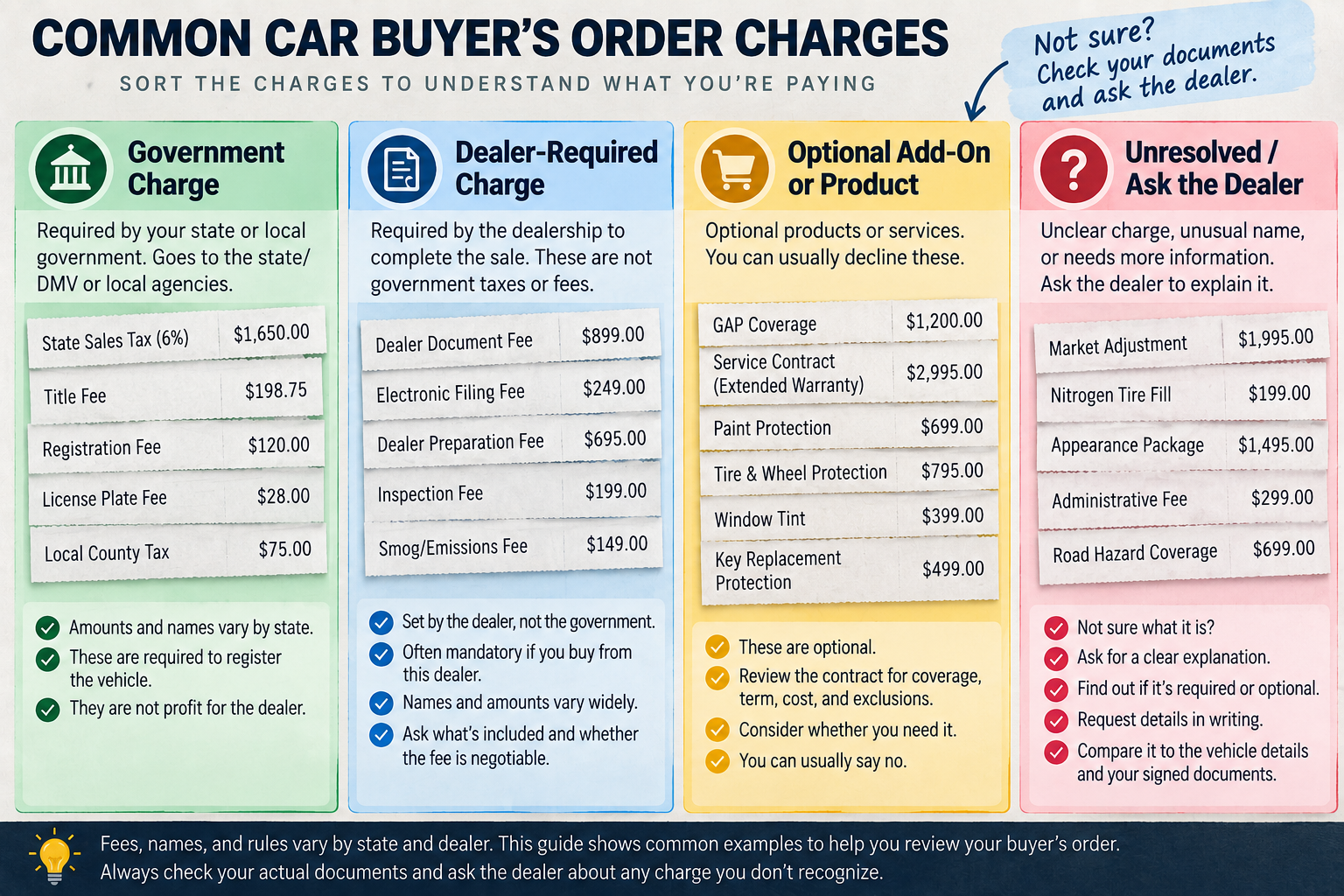
Government charge, dealer charge, or product?
This is the first split I make when reading a quote.
Government-required consumer charges can include taxes, title, registration, and similar amounts required by a federal, state, or local government. Exact names and amounts depend on the transaction and jurisdiction.
Dealer-required charges are charges the dealership requires as part of buying the vehicle. They may have names such as document, processing, administrative, preparation, or electronic filing fees.
Optional add-ons are separate goods or services. The FTC and CFPB give examples including GAP products, extended warranties or service contracts, window etching, protection products, and other aftermarket items.
Then there is a fourth bucket: I don't know yet. That is a perfectly valid category. If the paperwork does not tell you what a line means, the answer is to get an explanation, not invent one.
Dealer-required fees and the advertised price
This part changed from the vague advice you may have seen repeated for years. In September 2026, FTC staff published automobile pricing-transparency FAQs explaining how the FTC Act applies to advertised vehicle prices.
According to that guidance, the advertised price should be the price any consumer can actually pay for the vehicle, excluding government-required consumer charges. If the dealer requires a charge to buy the vehicle, the FTC says that dealer-required charge belongs in the advertised price. The FAQ specifically uses a mandatory document fee as an example.
That does not mean every fee with “document” in its name is illegal, or that state rules are all the same. The FTC guidance itself discusses differing state approaches to document fees. The important point for comparing an advertisement with the paperwork is that a mandatory dealer charge should not suddenly turn an advertised vehicle price into a higher dealer price.
Optional add-ons are a different question
Add-ons are where I would slow down and read the actual product name.
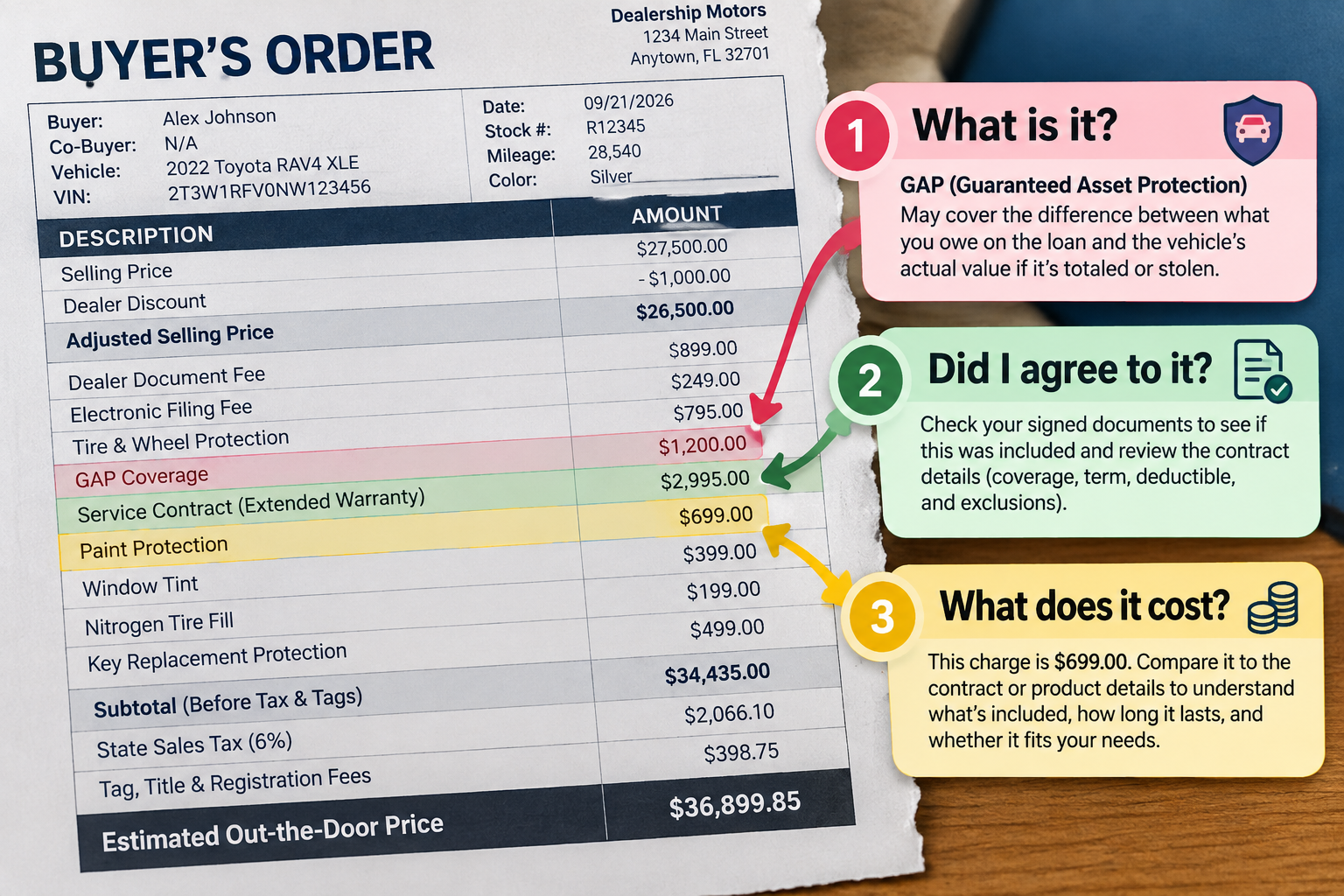
GAP, service contracts, extended warranties, window etching, paint or fabric protection, tire-and-wheel products, alarms, accessories, and similar items may appear on the purchase or financing paperwork. The CFPB says optional add-on products are not required simply to obtain dealer financing, and financing an add-on increases the amount you borrow and repay.
The FTC's current pricing guidance also says dealers cannot represent an optional item as required, claim an installed option cannot be removed when the consumer is not actually required to buy it, misstate its cost, or charge for an option the consumer did not agree to.
That does not make every add-on a bad purchase. It means you should know that you are buying it, know its price, and understand whether you agreed to it.
What about reconditioning or prep fees?
These labels show up often enough to deserve attention, but the name alone does not tell you the answer. A reconditioning charge may describe work the dealer says it performed before sale. A prep or service charge may describe something else entirely. What matters for your paperwork review is whether the charge is dealer-required, whether it was already reflected in the advertised price, and whether the dealer can explain what the line represents.
I would not try to decide from the word “reconditioning” whether the charge is legal, reasonable, or worth paying. Those are different questions and can depend on facts we do not have.
A five-minute fee check
- Circle every line you do not recognize.
- Separate obvious government charges from dealer charges.
- Mark products and add-ons separately.
- Ask whether each unclear item is required to buy the vehicle or optional.
- Compare the vehicle price and dealer-required charges with the advertisement or earlier written quote.
- Recalculate the OTD total so you can see where each amount lands.
If a label still does not make sense, write down the dealer's explanation. That is much more useful than trying to decode “PKG 2” from vibes.
Do not let the monthly payment hide the price
If you finance an optional product, it can disappear into a monthly payment that does not look dramatically different. That does not make the product free. The FTC recommends focusing on the written OTD price before discussing financing, and the CFPB notes that financed add-ons increase the loan amount.
Purchase price first. Financing second. It is much easier to see what changed when those two conversations are not mashed together.
What the OTD Decoder does with fees
The free decoder is built for the annoying middle step: you have the paperwork, but the labels and totals are hard to follow. Paste the relevant line items and it can organize likely vehicle-price lines, government taxes and fees, dealer charges, add-ons, adjustments, totals, and unresolved items.
It does not decide whether a fee is legal in your state, whether the car is fairly priced, or whether you should buy it. If the document does not provide enough information to classify something safely, unresolved is better than pretending.
Redact Social Security numbers, account numbers, dates of birth, and full street addresses before entering or sending paperwork.
If a fee is still bothering you
If you have already sorted the lines and there is still a charge you cannot place, or the paperwork changed in a way you cannot reconcile, the $19 Deal Sheet Second Look is a manual review. The goal is to identify what the sheet says, what changed, and what questions are worth taking back to the dealer.
Quick answers
Are dealer fees the same as government fees?
No. A dealer-required charge and a government-required consumer charge are different things, even if both appear on the same worksheet.
Does “non-tax fee” mean the fee is mandatory?
No. That label by itself does not tell you enough. Ask what individual charges make up the subtotal and who requires them.
Are GAP and extended warranties required for dealer financing?
The CFPB says products such as GAP, extended warranties, and credit insurance are generally optional rather than a requirement for an auto loan.
Can a dealer add a mandatory document fee on top of an advertised price?
FTC staff's September 2026 pricing guidance says dealer-required charges, including a mandatory document fee, must be reflected in the advertised vehicle price. Government-required consumer charges are treated differently. Individual circumstances and state requirements can add other disclosure questions, so this is not a determination about a particular transaction.